April 2026
The Fed and the Myth of 2% Inflation
Download PDF- The current spike in oil prices is a reminder that catalysts for higher inflation can emerge at any time. Despite a focus on the Federal Reserve’s 2% targeted inflation, it has rarely remained at that level for long.
- Once inflation rises, it is not easily reversed – especially if higher prices begin to shape consumer and business expectations.
- History shows that resetting inflation expectations and restoring price stability can be difficult and costly.
It was logical for the Federal Reserve to leave interest rates unchanged in March amid elevated economic and geopolitical uncertainty. Inflation has remained uncomfortably above 2% for several years, and not only are we seeing that past inflationary impulses are stronger, we are also seeing emerging signs of new inflationary pressures. And all of these precede the most topical concern: rapidly rising fuel costs stemming from the ongoing war with Iran. Despite these pressures, the economy has remained resilient, even amid concerns from consumers and investors alike. The Fed was right to signal caution about cutting rates for the time being. Yet an important question remains: Should the Fed focus more on mitigating inflation or supporting employment?
There is a strong case for prioritizing inflation risk. The current spike in oil prices is a stark reminder that catalysts for higher inflation can arise at any time. A review of inflation over the past century shows that it has often been more volatile – and often much higher – than recent experience might suggest.
In addition, the debate over whether the Fed should adjust interest rates often overlooks a crucial point. Most commentary focuses on the tradeoff between the Fed’s first two mandates under the Federal Reserve Act: maximum employment and stable prices. But the third mandate – maintaining moderate long-term interest rates – is often overlooked.
In previous commentaries, I have argued that the Fed has applied considerable latitude in interpreting this third mandate, effectively redefining it across eras through its actions. Today, I believe that mandate should explicitly be anchoring inflation expectations at the 2% target rate. The reason is straightforward: If people come to expect inflation above 2%, controlling it becomes far more difficult. The genie does not easily return to the bottle. With current sticky inflation, future inflation expectations have remained surprisingly anchored. But we must ask: How much longer can inflation run above 2% before those expectations become unanchored?
Inflationary consequences
When inflation accelerates, the near-term consequences are familiar. Companies face higher costs, many pass them on to consumers, and households lose purchasing power.
Less appreciated are the long-term effects. Since periods of deflation are very rare, particularly in the U.S., periodic episodes of elevated inflation can lead to sustained higher prices years into the future, even if current year’s inflation returns to 2%. What matters for savers and investors isn’t any single year of inflation, it is the average inflation experienced over the medium to long term. Such cumulative increases can steadily erode wealth over years or even decades. Retirement savings, for example, lose real value if inflation runs higher during accumulation years.
Before the COVID pandemic, these potential consequences were largely ignored because inflation remained subdued for more than a decade after the global financial crisis. At times, it was so low that the Fed worried about deflation. That benign period was highly unusual and may have created a false sense of confidence among consumers, businesses, investors, and policymakers that inflation would remain near or below 2% indefinitely.
The 2% inflation myth
In its March statement, the Federal Open Market Committee (FOMC) emphasized its goal of achieving inflation “ at the rate of 2 percent over the longer run” while noting that “implications of developments in the Middle East for the U.S. economy are uncertain.”
The committee’s four critical words about the inflation target are “over the longer run.” Despite confidence in stable, moderate inflation that arose before the pandemic, such stability is historically rare. Inflationary shocks – whether from pandemic-driven supply disruption, geopolitical conflict, or other sources – can reshape public expectations about future inflation if not addressed quickly.
Looking at rolling 30-year periods since the end of the Great Depression – a reasonable proxy for a working lifetime of saving for retirement – long term averages for U.S. inflation generally ranged between 3% to 5% annualized until the aftermath of the 2007–2009 financial crisis (see chart).
2% Inflation Has Been the Exception, Not the Rule
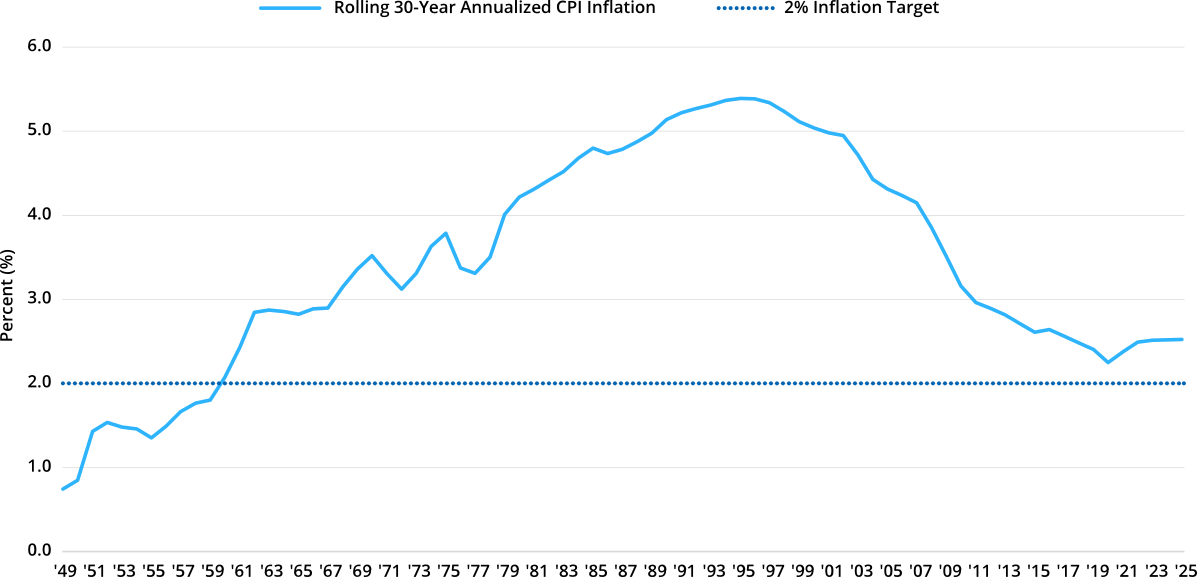
During this period, inflationary spikes were common enough to push average annualized inflation well above the Fed’s 2% target for the bulk of the last century. Further, because there are rarely periods where prices outright decline, these temporary spikes cause real world users to experience a long-run inflation reality that is wholly inconsistent with the Fed’s 2% goal. A sense of complacency is understandable given the oddity of our most recent experience, but with the post-COVID inflationary shock and more recent potential for inflation from tariffs, deglobalization, and the current spike in oil prices, now is the time to be vigilant.
The case for a hawkish Fed
Inflation expectations can reinforce persistent inflation trends that are difficult to reverse. Japan’s long struggle to escape the deflationary mindset that took hold in the late 1990s is a stark example. Only recently has the Bank of Japan begun to move away from negative short-term interest rates and government bond purchases.
The U.S. offers a parallel lesson. In the 1970s, the Fed allowed high inflation expectations to become embedded. After Paul Volcker became Fed chair, the central bank hiked rates more aggressively. Even then, it took repeated tightening and a federal funds rate at a record 20% to break inflation and reset expectations, at the cost of a severe recession.
Given these risks, the Fed must remain vigilant. Anchoring inflation expectations should be critical to its mission. With oil prices high even as the Fed continues to address lingering post-pandemic inflation, the FOMC should be prepared to raise rates, not lower them.
Any performance data quoted represents past performance, which does not guarantee future results. Index performance is not indicative of any fund’s performance. Indexes are unmanaged and it is not possible to invest directly in an index. For current standardized performance of the funds, please visit www.AristotleFunds.com.
The views expressed are as of the publication date and are presented for informational purposes only. These views should not be considered as investment advice, an endorsement of any security, mutual fund, sector or index, or to predict performance of any investment or market. Any forward-looking statements are not guaranteed. All material is compiled from sources believed to be reliable, but accuracy cannot be guaranteed. The opinions expressed herein are subject to change without notice as market and other conditions warrant.
Investors should consider a fund’s investment goal, risk, charges and expenses carefully before investing. The prospectuses contains this and other information about the fund and can be obtained at www.AristotleFunds.com. It should be read carefully before investing.
Investing involves risk. Principal loss is possible.
A full list of holdings can be found at www.aristotlefunds.com and are subject to risk and to change at anytime. Any discussion of individual companies is not intended as a recommendation to buy, hold or sell securities issued by those companies.
Foreside Financial Services, LLC, distributor.